
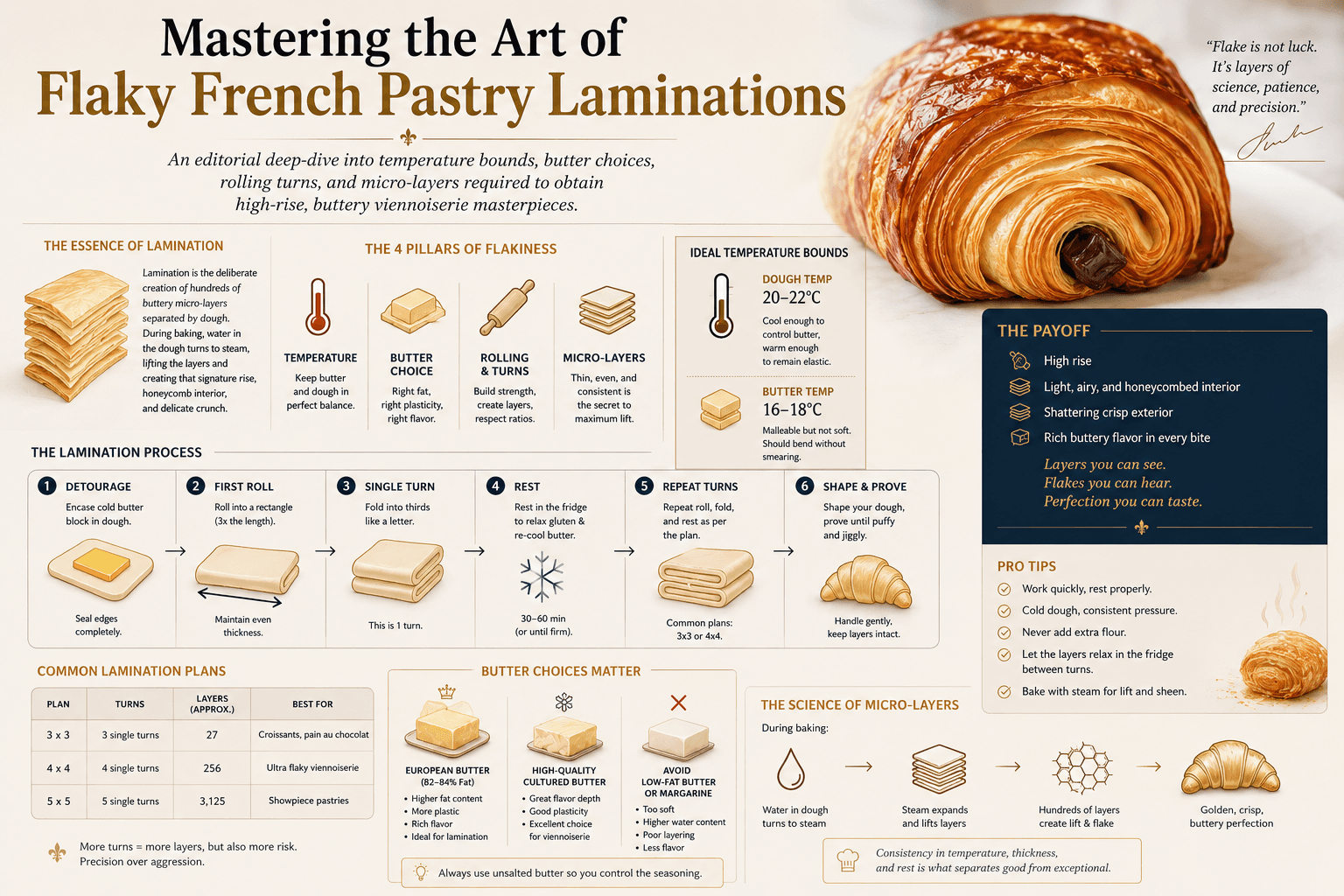
Mastering the Art of Flaky French Pastry Laminations
An editorial deep-dive into temperature bounds, butter choices, rolling turns, and micro-layers required to obtain buttery viennoiserie masterpieces.
Discover the physics of croissant baking. Learn how butterfat elasticity, single vs booklet turns, and steam leavening produce flaky, cellular crumbs.
Mastering the Art of Flaky French Pastry Laminations
Cutting into a classic French croissant should reveal a delicate, honeycomb-like interior. When you bite into it, the crust should shatter into hundreds of paper-thin flakes. This cellular, buttery structure is achieved through lamination—the process of folding butter into dough to create alternating micro-layers.
Baking flaky pastries is a game of temperature control, fat choices, and mechanical precision. Let’s break down the science of lamination.
1. The Butter Block Boundary (Beurrage)
The success of lamination depends on maintaining two distinct phases: the dough (détrempe) and the butter block (beurrage).
Plasticity and Temperature Synchronization
To roll out the dough and butter together without them mixing, they must have the same consistency.
- If the butter is too cold: It will shatter into hard shards when rolled, cutting through the dough and ruining the layers.
- If the butter is too warm: It will melt and absorb directly into the dough starches, turning your pastry into standard brioche dough rather than flaky layers.
Butterfat Content
Use European-style butter with 82% to 84% butterfat. Standard American butter contains more water (up to 18-20%). This water evaporates during rolling, leaving the butter crumbly. European butter is churned to a higher fat content, making it flexible and easy to roll into thin sheets.
2. The Folding Mechanics: Single Turn vs. Double Turn
Folding creates the thin layers that lift the pastry as it bakes. The two primary folds are:
The Single Turn (Envelope Fold)
Roll the dough into a rectangle, cover two-thirds of it with butter, and fold the unbuttered third over the center, followed by the remaining third. This fold triples the number of layers.
The Double Turn (Book Fold)
Fold the two outer edges of the dough rectangle so they meet in the center, then fold the dough in half like a book. This fold quadruples the number of layers.
Lamination Limits: A classic croissant uses three single folds, creating 81 layers of butter. If you fold the dough too many times, the layers become so thin that the butter merges into the dough, resulting in a bread-like texture.
3. Steam Expansion: How Croissants Rise
Laminated pastries do not rely on yeast alone to rise. The primary leavening agent is steam.
Oven Heat ──> Water in Butter turns to Steam ──> Gluten Layers Lift ──> Honeycomb Crumb Sets
When the cold, layered dough enters a hot oven (400°F / 204°C), the water trapped within the butter layers turns to steam. As the steam expands, it pushes the surrounding gluten sheets upward.
The butter melts, coating the dough layers in fat and frying them to create a crispy, flaky texture. As the starches bake and set, they lock the open, airy honeycomb structure into place.
4. Chilling and Dough Relaxation
During rolling and folding, the gluten proteins in the dough are stretched and build tension. If you try to roll the dough out immediately after folding, it will shrink back, and the tension will tear the butter layers.
- Resting: Rest the dough in the refrigerator for at least 30 minutes between folds to relax the gluten network.
- Chilling: Keeping the dough cold ensures the butter fat remains solid and stable.
5. Troubleshooting Pastry Lamination FAQ
Why is butter leaking out of my croissants during baking?
Butter leaks when the dough was under-proofed or proofed at a temperature that was too warm. If the proofing temperature exceeds 82°F (28°C), the butter melts out of the layers before the dough structure has set. Additionally, if the croissants are under-proofed, the steam cannot expand properly, causing the butter to run out onto the baking sheet.
Why are my croissants dense and bread-like inside?
This is caused by the butter melting into the dough during rolling. Ensure your kitchen is cool (under 68°F / 20°C) and chill the dough thoroughly between folds.
Can I proof croissants overnight?
It is best to shape them, freeze them, and thaw them in the refrigerator before proofing them at room temperature (75°F / 24°C) for 2 to 2.5 hours before baking.
Conclusion
Pastry lamination is a beautiful combination of food science and manual skill. By keeping your ingredients cold, using high-fat butter, resting the dough to manage gluten tension, and baking with high heat to create steam, you can achieve beautiful viennoiserie bakes.