
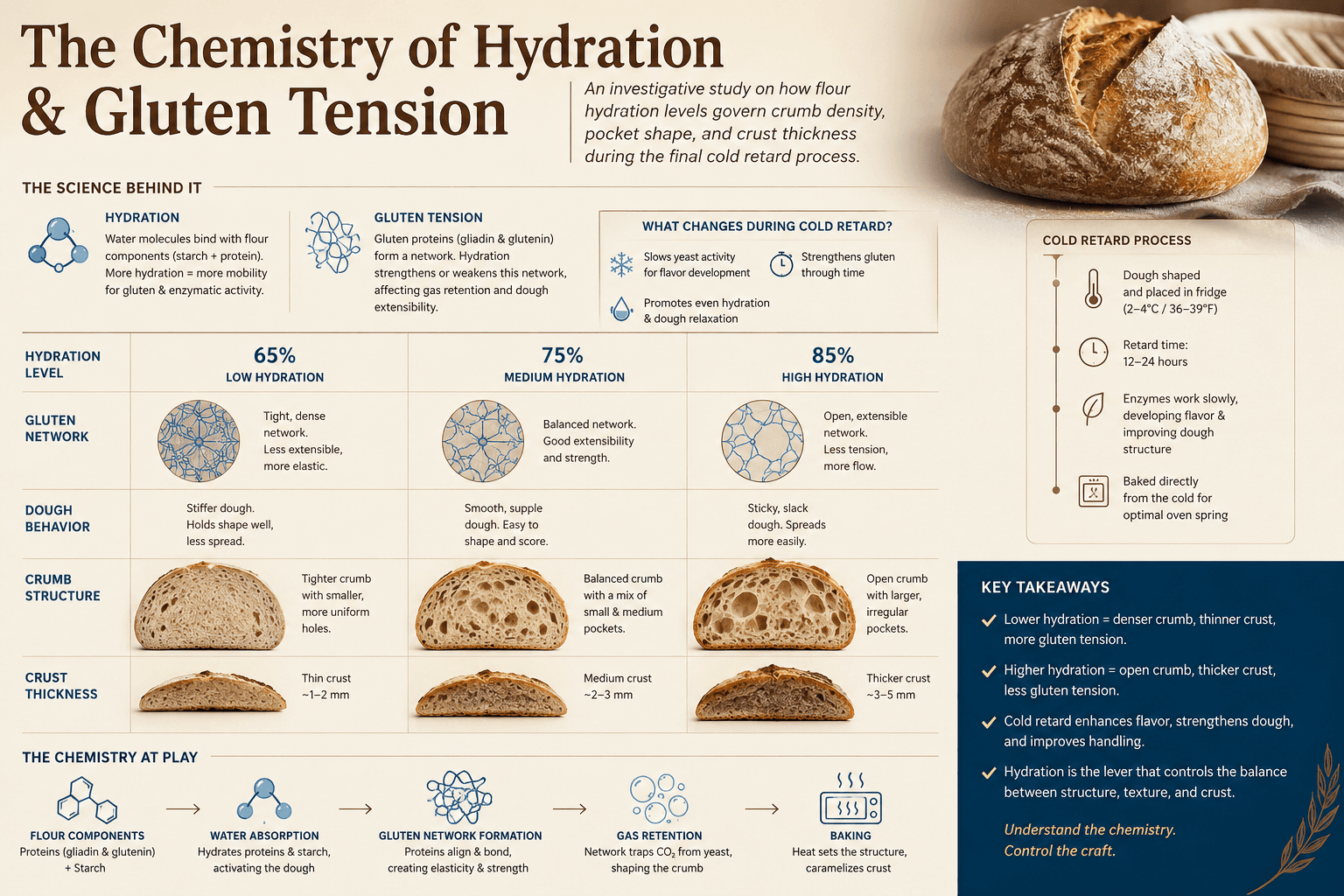
The Chemistry of Hydration & Gluten Tension
Discover how flour hydration levels, gluten protein alignment, and stretch-and-fold cycles govern gas retention and crumb density in baking.
An in-depth food science analysis of gluten matrix development. Learn how disulfide covalent bonding and water molecules interact to construct the perfect bread crumb.
The Chemistry of Hydration & Gluten Tension
Every baker dreams of cutting into a fresh loaf of bread to find a glassy, translucent interior filled with irregular, airy pockets—the legendary "open crumb." While many attribute this to the oven or the starter, the foundation of open crumb is built on chemistry, specifically the development of gluten tension and water hydration.
To control your bakes, you must look beyond the mixing bowl and understand the biochemical forces that govern dough elasticity, extensibility, and gas retention.
1. The Biochemistry of Gluten: Gliadin and Glutenin
When wheat flour is dry, its storage proteins—gliadin and glutenin—are crumpled and inert. The moment water is introduced, a chemical transformation begins.
The Role of Water Hydration
Water acts as a plasticizer. It hydrates the proteins, causing them to unfold and interact. Under the mechanical energy of mixing or folding, these proteins link together via disulfide bonds to form a cohesive, three-dimensional matrix known as gluten.
The Balancing Act
- Gliadin: This monomeric protein acts as a lubricant, providing extensibility. It allows the dough to stretch and expand without tearing as steam and carbon dioxide swell.
- Glutenin: This polymeric protein forms long, high-molecular-weight chains, providing elasticity and tensile strength. It acts as the structural springback force that resists deformation, allowing the loaf to hold its shape during proofing and rise upward rather than spreading outward.
2. The Thermodynamics of High Hydration: 65% vs. 80%
Hydration levels represent the weight of water relative to the weight of flour. A 65% hydration dough is firm, easy to knead, and produces a tight, uniform crumb structure (ideal for sandwich breads).
An 80% hydration dough contains far more water molecules. This excess water increases molecular mobility, allowing gluten strands to align with less friction. However, because excess water acts as a lubricant, traditional mechanical kneading is counterproductive. Intensive kneading breaks the delicate protein bonds of highly hydrated dough.
Instead, strength is developed through time and gentle manipulation, such as bulk fermentation folds. This allows the gluten to self-organize into continuous sheets, trapping larger pockets of steam and carbon dioxide to yield an open, honeycomb crumb.
3. Creating Gluten Tension: Stretch-and-Folds
Mechanical energy aligns messy, tangled gluten strands into neat, parallel arrays.
Rather than traditional kneading, which tears these strands, artisanal bakers use periodic stretch-and-folds during bulk fermentation.
How to Perform a Stretch-and-Fold
1. Slide a wet hand under one side of the dough.
2. Pull the dough upward gently until you feel tension.
3. Fold it over the top of the dough.
4. Rotate the bowl 90 degrees and repeat.
The Science Behind the Stretch
Stretching pulls the protein chains tight, aligning them and facilitating the formation of disulfide covalent bonds. Folding stacks these aligned sheets on top of one another, creating a layered, multi-ply structure.
This process strengthens the dough's "skin" (outer tension), allowing it to rise high and support its own weight during the final proof.
4. Gluten Relaxation: The Autolyse Phase
Before adding yeast or salt, mixing the flour and water and letting it rest is called the autolyse phase.
- Protease Enzymes: During the autolyse, natural enzymes called proteases break down a small portion of the peptide bonds in the gluten matrix. This relaxes the dough, increasing its extensibility.
- Easier Shaping: A relaxed dough is easier to shape without tearing.
- Salt Inhibition: Salt is a gluten tightener and dehydrates the proteins. By keeping salt out of the autolyse, you allow the flour to hydrate fully and enzymes to perform their work unimpeded.
5. Troubleshooting Gluten Structure FAQ
Why does my dough tear when I stretch it?
This is a sign of under-hydration or insufficient autolyse. The protein chains are still dry and coiled, resisting stretch. Increase your autolyse to 60 minutes or slightly increase the water content.
Why does my dough spread flat after shaping?
This indicates weak gluten structure or over-proofing. If you do not perform enough stretch-and-folds, the dough won't have the tensile strength to hold its shape. If the dough is over-proofed, the acids produced by bacteria have broken down the gluten matrix, causing it to collapse.
What is the "windowpane test"?
To check gluten development, cut a small piece of dough and stretch it gently between your fingers. If you can stretch it into a thin, translucent membrane without it tearing, your gluten network is fully developed and ready to trap gas.
Conclusion
Understanding the molecular relationship between water and protein allows you to master dough handling. By balancing hydration, allowing proper autolyse relaxation, and building tension through stretch-and-folds, you can achieve bakery-quality bread with a beautiful open crumb.